On the 8th of May 2026, a closed-door conversation in Zürich brought together investors, foundation principals, and operators from across the nature and biodiversity space to take apart the conventional model of nature finance. The conversation was hosted by Wyss Academy for Nature, in collaboration with Amazonia Impact Ventures and Innpact, and anchored by a live case from the Peruvian Amazon. It produced one of the sharpest diagnostic moments of The Decision Room Edition I, an event that brought together more than 160 decision-makers representing over $100 billion in assets under management.
This essay starts from that conversation, then builds outward. The diagnosis and the core argument are what the room produced. The supporting detail, the named companies, the figures, the policy context, comes from research conducted afterward to test and extend what was said. Where a claim is attributed to "a participant" or "the room," it reflects something said in the conversation. Everything else is verified independently. It is for investors, founders, philanthropic principals and operators who have run out of patience with the gap between intention and outcome..
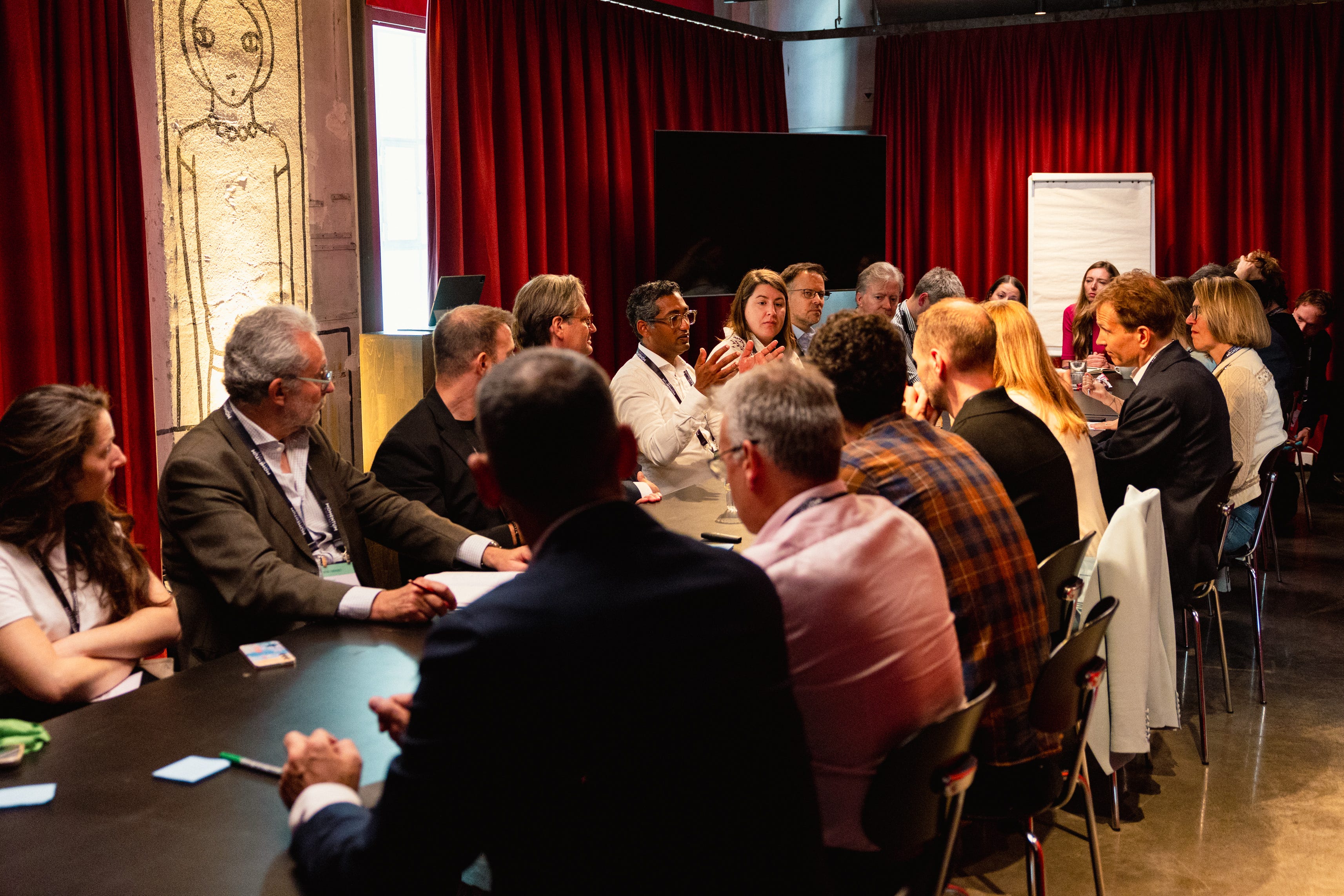
Edition II · 11 May 2027, Zürich
The conversation this essay is built from was one of eight at Edition I. Edition II is where the diagnosis becomes work: the capital stack mapped, the commitments tracked, the same rooms reconvened with the people who can move them.
The wrong question
For most of the last decade, the central question in nature finance has been some version of: how do we make capital flow to nature? It is the wrong question. It assumes the problem is supply. It assumes that if enough capital is mobilised, enough projects will be funded, and enough projects will deliver.
The evidence from the room said the opposite. The problem is not supply. The problem is structure. The pipes are leaking. The instruments are mismatched. The timelines are wrong. And the dominant model of how to deploy capital into nature, borrowed wholesale from conventional asset management, is producing the outcome it was always going to produce: capital pooled in the institutions that can absorb it, not in the ground.
The conversation did not produce a manifesto. It produced a diagnosis. And it produced a counter-thesis to the way nature finance is conventionally structured.
This essay starts from the closed-door conversation, then builds outward. The diagnosis and the core argument are what the room produced. The supporting detail, the named companies, the figures, the policy context, comes from research conducted afterward to test and extend what was said. Where a claim is attributed to “a participant” or “the room,” it reflects something said in the conversation. Everything else is verified independently. It is for investors, founders, philanthropic principals and operators who have run out of patience with the gap between intention and outcome.
It argues four things.
One. Nature finance, in its current form, is misdescribed as a portfolio problem when it is in fact a value-chain problem.
Two. Concentration across a single value chain de-risks each node and the system, while conventional diversification protects no one in nature.
Three. The standard 2/20 fund management model is structurally incompatible with the unit economics of impact in the Global South.
Four. With public first-loss capital retreating, the natural replacement is philanthropic and family-office capital, but only if it is reframed as catalytic rather than expendable.
The leakage
A participant in the conversation offered a number that stopped the room. Less than 0.02% of capital pledged for nature reaches on-the-ground projects in the Global South. The figure is contested and the methodology behind it is not in the public record. But its directional claim is unarguable.
To understand why, consider how a typical commitment travels. A government, a foundation, or a multilateral announces a billion-dollar pledge for nature finance. The pledge flows to a development finance institution, which absorbs the overhead, the staffing, and the structuring costs. A layer is taken. The DFI deploys what remains through a fund of funds. Another layer is taken. The fund of funds allocates to managers, who take 2% per year on assets under management regardless of outcome, and 20% of any upside they generate. Another layer. The managers deploy into projects sized to absorb their cheques, which means projects sized at $5 million and above. Projects below that threshold, which is most projects in most landscapes, are structurally invisible to this capital. The architecture is real even if no single commitment maps exactly to this path. Each layer is doing what it was incentivised to do. The cumulative effect is what the 0.02% figure points at.
This is not a bug. This is the system working exactly as designed.
The structural pressure on this system intensified through 2024, 2025 and into 2026. Germany’s BMZ, historically one of the largest providers of first-loss capital in climate and nature funds, has been in active retreat. Its budget fell from €13.8 billion in 2022 to €10.05 billion approved for 2026, with longer-term projections pointing toward roughly €9.3 billion by the end of the decade. In January 2026, Minister Reem Alabali Radovan presented the BMZ’s reform plan, “Shaping the Future Together Globally,” telling reporters plainly: “We will not do everything everywhere, but sharpen our regional focus.” The ministry’s remaining commitments narrowed to the EU neighbourhood, North Africa and the Middle East, the Sahel, Sudan and the Horn of Africa, with climate-environment work in Latin America and Asia significantly scaled back. The 2025 OECD figures, released in April 2026, confirm a broader collapse: total DAC official development assistance fell 23.1% in a single year, to $174.3 billion, the steepest annual drop on record.
Public first-loss capital, the layer that has historically made it possible for institutional money to enter nature deals at all, is shrinking at the precise moment the room agreed it is most needed.
The conventional response is to call for more pledges, larger funds, and more aggregated capital. The room rejected this response. Larger funds make the leakage worse, not better. They push the average cheque size higher, which pushes the deployable opportunity set further away from the landscapes and communities that need capital most.
The response the room actually converged on was structural. The model has to be rebuilt around four ideas, each of which inverts a conventional assumption. First, concentrate capital across a single value chain instead of diversifying across unrelated assets, because in nature the risks are correlated and diversification protects no one. Second, redesign the fee model so the manager’s incentive aligns with the landscape’s outcome, not with assets under management. Third, replace the retreating public first-loss layer with catalytic philanthropic and family-office capital, structured as investable rather than expendable. Fourth, treat trust as infrastructure rather than as an output of better data, and fund the slow relationship work that conventional models cannot pay for.
Each of these is the subject of one of the sections that follow. The Brazil-nut case is the first proof point.
The Amazon-nut case
Bertholletia excelsa is a tree that can reach 50 metres and live for 500 years. It does not grow in plantations. It depends on a specific guild of bees, more abundant in primary forest than in disturbed or regenerating land, to pollinate it. It depends on the agouti, the only rodent capable of breaking open the hard pod that protects the seeds, to regenerate. Take away the forest, you lose the bees. Lose the bees, you lose the trees. To produce Brazil nuts at commercial scale, the forest has to remain standing.
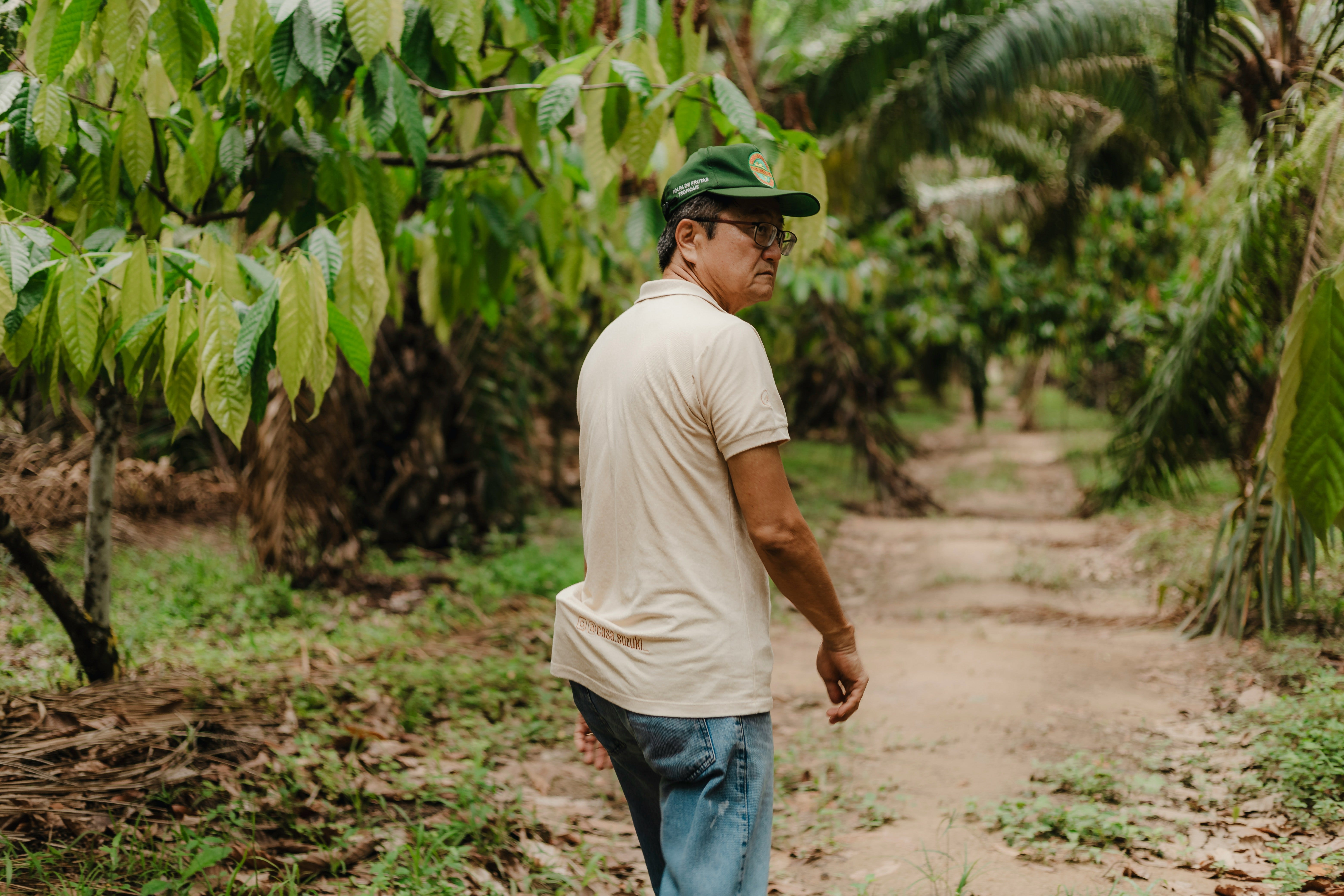
The Brazil-nut forests of Madre de Dios cover more than two million hectares, around 30% of the region. Twelve and a half per cent of the regional population works in the industry. Around 1,000 individuals hold government-granted concessions ranging from 25 to 4,000 hectares. The harvest runs December to April. Pods, softball-sized, holding twenty or so seeds, fall from the canopy through the wet season. Each tree drops around 300 pods per season. Falling pods can cause traumatic brain injuries and have killed harvesters. Collectors walk their concessions, gather the fallen pods with a hooked stick called a pallana, carry them in tamshi-fibre baskets weighing 60 to 70 kilos back to camp. The pods are split open, the nuts dried and sorted, and hauled to a processing plant. Most concession-holders earn more than half their family income from the harvest. Around a third of concession-holders are women. In 2023, Peru exported 5,500 metric tons of shelled nuts for around USD 30 million. The top buyers were importers in Germany, the United States, the United Kingdom, the Netherlands and France.
The pressure on the chain is real and named. Some 80,000 hectares of Brazil-nut concessions overlap with mining or farming rights, the legacy of uncoordinated land-use decisions by different ministries. Illegal gold mining, illegal logging, and forest conversion to small-scale ranching are the primary threats. The economic alternative for a Brazil-nut concession-holder is to sell the land.
Amazonia Impact Ventures (AIV) operates a $25 million impact-linked debt fund deploying capital across the agrifood value chains of the Peruvian, Ecuadorean, Colombian and (soon) Brazilian Amazon. The fund is structured with catalytic capital alongside commercial capital, and it deploys through impact-linked loans, debt instruments that price down when borrowers hit sustainability-linked targets tied to forest conservation, restoration, gender outcomes and community benefit. AIV has made roughly $9 to $11 million across some 35 to 45 impact-linked loans, across 12 value chains, reaching 4,000 to 5,200 producers, of whom approximately 36% are women and 32% Indigenous. The fund touches 160,000 hectares under improved management.
What is unusual about AIV is not the volume. It is the architecture.
In Madre de Dios, AIV is not invested in “the Amazon.” It is invested in the Brazil-nut chain specifically. It supports two cooperatives: AFIMAD, the Madre de Dios Indigenous Forestry Association, formalised around 2009 and now representing 200 families across the Yine, Ese Eja, Amahuaca and Shipibo peoples in six native communities; and RONAP, the wild-harvester association whose nuts move from Madre de Dios to coastal Peru and then to international buyers. Between 2021 and 2024, AIV deployed roughly $770,000 across four repeated loan rounds to these two cooperatives, who collectively manage more than 115,000 hectares of standing forest. Interest rates are tied to traceability and conservation conditions, so the cost of capital moves with the integrity of the supply. The Wyss Academy operates in the same landscape on the upstream side, supporting the ecological and institutional conditions, agroforestry, eco-tourism, mining-landscape restoration, that determine whether the chain has a future. Innpact provides the blended-finance structuring expertise that allows the catalytic layer to sit alongside the commercial layer without confusing the price of risk.
Now follow the chain back from the buyer. An importer in Germany or the United States can verify, of a given consignment of shelled nuts, which cooperative they came from, and within the cooperative, which concession. Because they can verify it, they pay a premium. The premium flows back to the processing plant, which pays the cooperatives more per kilo. Because the cooperatives earn more, they pay the harvesters more. Because the harvester families earn more from the standing forest, they have less reason to sell the concession to a miner or a logger. Because the forest stays standing, the bees keep pollinating, the agoutis keep dispersing the seeds, and the trees keep producing. The chain has a future.
Each investment de-risks the others. When producers have stable income from harvest, they protect the standing forest, because the forest is the asset. When processors have access to working capital with traceability conditions tied to their cost of debt, they pay producers more, because cheaper debt rewards them for paying upstream. When off-takers can verify provenance to the level of an individual concession, they pay a premium, which flows back into the producer cash-flows that protect the forest. The system has feedback loops. It is not a portfolio in the conventional sense. It is a chain in which each link makes the others more solvent.
A conventional portfolio manager would look at this and call it concentration risk. One geography, one species, one ecosystem, one set of off-takers, one weather corridor. The textbook would say to diversify across uncorrelated assets to reduce variance.
The room rejected this framing. The variance, in nature, is not uncorrelated. If the Brazil-nut harvest fails, the producer community loses income, the forest comes under pressure, the processor cannot fill orders, the off-taker cannot meet contracts, and the lending fund’s portfolio is hit. The risks across nodes are intensely correlated. Diversification across unrelated assets does not reduce that correlation. It only ensures that when the chain breaks, the manager has other places to point.
Concentration with depth is different. Concentration with depth means that when one node weakens, the others can carry it, because the same capital that finances the processor can be redirected to support the producer, and the same trust infrastructure that took years to build remains available. Conventional portfolios maintain optionality. Value-chain investing builds reciprocity. Reciprocity is a stronger insurance product in landscapes where the alternative is collapse.
This is the anti-portfolio. It is not new in theory. Specialist agrifood investors have known it for decades. But it is in active opposition to how multilateral capital, sovereign capital, and most institutional capital deploy into nature, and that is the gap the room was naming.
The 2/20 problem
The second structural finding from the room was simpler and more uncomfortable. Several participants challenged the standard fund-management fee model directly. The 2-and-20 structure, two percent of assets under management as an annual fee plus 20% of upside as carried interest, is the dominant economic engine of impact and venture finance. The room argued it is structurally incompatible with the economics of impact in the Global South.
The mechanics are straightforward. A fund manager’s income scales with the size of the fund, regardless of impact delivered. The incentive is therefore to raise larger funds. Larger funds need to deploy in larger cheques to keep operating costs under control. Larger cheques systematically exclude smaller projects. Smaller projects are where the durable, community-level impact in nature actually lives.
This is not a moral failure of fund managers. It is a design feature of the instrument. A manager running a $300 million fund cannot rationally cut $250,000 cheques into Indigenous producer associations, because the cost of due diligence, structuring, monitoring and reporting per cheque does not scale down. The fund’s economics force it upmarket. The instrument is doing what it was built to do.
Several funds in the room are experimenting with alternatives. Carry tied to impact KPIs rather than purely to financial return. Lower management fees in exchange for catalytic first-loss tranches. Hybrid structures that pool philanthropic and commercial capital with different return expectations sitting at different positions in the stack. None of these are mature. Many are politically difficult inside fund partnerships, because they reduce the manager’s economic upside.
But the principle is the one the room kept returning to. The cost of capital for the project has to be lower than the return the landscape can generate. In conventional fund economics, that maths often does not work. In well-designed blended structures, it can. Innpact, the room’s blended-finance specialist, has spent fifteen years building exactly the kinds of vehicles that allow philanthropic and commercial capital to sit together without one distorting the other. The technical knowledge exists. The willingness to use it at scale does not yet match the need.
The first-loss vacuum
If the structural argument is that conventional fund economics cannot serve the projects that most need capital, the operational argument is that the layer of capital which has historically bridged that gap is shrinking.
First-loss capital, the tranche that absorbs initial losses to make a deal investable for institutional follow-on, has historically come from three sources. Public development finance, primarily DFIs and their parent ministries. Multilateral concessional capital. And philanthropy, where it has been willing to act commercially.
The first source is retreating. BMZ’s budget cuts are the most visible case, but they are part of a broader DAC-wide contraction. The second source is fragmented and slow. The third source is large but mostly inactive in the way it would need to be.
Global philanthropic capital is enormous in aggregate. The Wyss Foundation alone has committed CHF 100 million of the CHF 200 million Wyss Academy programme. The combined assets of European foundations run into the hundreds of billions. But most of this capital is structured as endowment, with conservative investment mandates that exclude the kinds of catalytic first-loss positions nature finance now requires.
The Swiss regulatory environment is illustrative. Foundations registered in Switzerland face significant constraints on using philanthropic capital in profit-generating vehicles. The risk-return-impact triangulation that catalytic capital requires sits in a legal grey zone that most foundation boards are unwilling to enter without specialist counsel. The result is that capital which is morally aligned with the work sits in conservative pools, while the work itself goes underfunded.
This is reformable. It requires three things. First, regulatory clarification on the use of endowment capital in mission-aligned vehicles, beginning with Switzerland and Germany where the foundation capital base is largest in Europe. Second, the development of standardised structures that allow foundation boards to participate without bespoke legal work on every deal. Third, a cultural shift inside foundation governance that recognises catalytic deployment as a continuation of mission, not a departure from it.
None of these are technical problems. They are coordination problems. They are exactly the kind of problem The Decision Room exists to surface.
Trust as infrastructure
The room returned, repeatedly, to one underdiscussed variable: trust. Not as sentiment. As infrastructure.
The technical apparatus of nature markets has matured significantly. Measurement, reporting and verification standards, satellite monitoring, registry technology, certification frameworks. The CRCF, the TNFD framework, the Science Based Targets Network for Nature, the UK Biodiversity Net Gain registry, all of these have made measurable progress. Where they remain weakest is not in the technical layer. It is in the trust layer.
A participant described it precisely. Trust is not produced by better data. It is produced by relationships. Multi-year, person-to-person, repeated commitments between off-takers, developers, investors and communities.
A participant cited the case of an Indigenous community in Mexico that spent five years building its own carbon project. They did not commission a methodology from a consultancy. They wrote their own. They did not contract a verifier to run the measurement, reporting and verification. They learned it themselves. When the first credits were issued, the community returned 92% of the proceeds directly to the families who had done the work. The buyers were not charity buyers. They were commercial off-takers who had spent the same five years building the relationship. This example was offered by the room as illustrative rather than independently audited, but the logic it points to is the one most participants converged on: the methodology was credible because the community designed it, and the economics worked because the layers of intermediation had been compressed. Most carbon projects in the Global South return less than half the value of the credit to the communities who hold the land; this one, as described in the room, returned 92% because the trust infrastructure was built before the instrument was designed, not after.
This is the operating principle that distinguishes value-chain investing in nature from financial-instrument trading in nature. Trust travels slowly. It cannot be accelerated through better software. It can be accelerated through repeated convening, repeated commitment, and a willingness by capital to enter conversations before instruments are designed, rather than after.
Most institutional capital cannot do this. The internal procurement, due-diligence and approval cycles of pension funds, insurers and sovereign wealth funds are not built for it. The result is that the trust infrastructure in nature finance is being built, where it is being built at all, by specialist funds, foundations and a small number of corporate buyers. This is structurally fragile. It depends on individual relationships and the continuity of specific people.
The room agreed that this fragility is a sectoral problem, not a project problem. Solving it requires institutional commitment to the convening function, to the slow work of relationship infrastructure that no individual deal pays for. That is true for The Decision Room. It is also true for the foundations, DFIs and corporates that are best placed to underwrite the work.
What we are building from it
Three commitments came out of the conversation. The Decision Room is now reconvening the cohort to convert them into work.
The first commitment was for Wyss Academy and Amazonia Impact Ventures to propose a format for continued collaboration around the value-chain investment logic the case demonstrated. The second was to map a logical capital stack for nature-positive investments in high-risk contexts. The third was to examine the regulatory and tax frameworks, beginning with Switzerland, that prevent foundations from using endowment capital in profit-generating vehicles.
These are not panel commitments. They are real work. We are convening the cohort that was in the May conversation to begin mapping the capital stack it described, and to define what the programme of work looks like from here. What follows, the working sessions, the in-person gatherings, the published outputs, will be shaped by that conversation, not handed down to it.
The work is the point. The event is the architecture around it.
The position
The implication of all this, for any reader trying to deploy capital into nature, is that the standard playbook is failing in a particular and structural way. The playbook diversifies when it should concentrate. It fees away the value when it should align it. It waits for first-loss tranches that are no longer arriving. And it treats trust as an output of better data rather than as the infrastructure on which everything else rests.
The alternative is not a single fund product or a single deal structure. It is a posture. Pick the chain. Go deep across the nodes. Build catalytic structures that let philanthropic capital sit alongside commercial capital without one distorting the other. Reform the fee model so that the manager’s incentive aligns with the landscape’s outcome. And invest in the relationship infrastructure, the slow trust-building work, that the conventional model cannot pay for.
This is harder than running a diversified fund. It produces fewer logos for the annual report. It does not scale linearly with capital under management. It demands patience that quarterly reporting cycles cannot accommodate.
It is also the only model the evidence suggests will work.
The room in Zürich was not unanimous on every point. There were sharp disagreements on the right size of catalytic tranches, on the role of carbon revenue in landscape-level deals, on the right balance of speed and rigour in MRV. There was no disagreement on the diagnosis. The conventional model is leaking capital, mispricing risk, and excluding the projects that most need to be funded. Something else has to be built.
Edition II will return to this question with the commitments tracked, the capital stack mapped, and the regulatory work scoped. The next gathering is on 11 May 2027 in Zürich. The work between now and then is not the event. It is the architecture being built around it.
If your work intersects with what the room described, the door is open.
Ways in.
Apply for Edition II. The full event is capped at 400. Each roundtable is capped at 20. If the early allocation fills before September, the current rate will close early. → Apply for access
Partner the room. Partnership is editorial, not decorative. Co-host a roundtable. Shape the programming. Sit at every conversation that matters to your thesis. → Read the Partner File → Apply to partner
Reply to this email if any of the work streams above are yours. We will be in touch directly.
Co-founder,
The Decision Room aaron@thedecisionroom.net
The Decision Room is an invite-led climate and frontier-tech capital convening. Once a year. Zürich. This essay is the second in a series of eight, one per closed-door conversation from Edition I. The full record is Before Capital Flows.
Reply to this email if any of the workstreams above are yours. We will be in touch directly.
The Decision Room is an invite-led climate and frontier-tech capital convening. Once a year. Zürich. This essay is the first in a series, one per closed-door conversation from Edition I, written by Aaron C. Leaman. The full record is Before Capital Flows