Aaron LeamanComplex communications
Changemakers · Climate

The Problem With Climate Messaging (and How to Fix It)

And What You Can Do to Cut Through Noise, Create Belief, and Drive Change

Welcome back to Changemakers, the newsletter for founders, storytellers, and communicators building the next generation of impact-led ventures.

This edition tackles something urgent: Why climate communications keep failing and what neuroscience and story structure can teach us about making people care.

Today’s topics..

Spotlight: The Real Cost of Flat Climate Messaging
Insight:
The Neuroscience of Why Story Changes Everything
For Founders:
A Better Way to Lead Through Story

Drop us a note anytime at mission@brighterfuture.studio. We’d love to hear your thoughts on this newsletter.



Spotlight: The Real Cost of Flat Climate Messaging

Every week brings new data, dire warnings, and policy recommendations.
And yet? The public response is muted. Often indifferent. Sometimes paralysed.

It’s not because people don’t care. It’s because much of what they hear lacks what the brain, and the heart, need to act - emotional clarity, human stakes, and a reason to remember.

This week, we explore why that matters - and how founders, leaders, and creatives can start to change it.

Baroness Brown of the Climate Change Committee recently said:

“We can’t wait to take action. This is not tomorrow’s problem, it’s today’s problem. If we don’t do something about it, it will become tomorrow’s disaster.”

She’s right - but almost no one noticed.

Technically sound. Strategically correct.
But emotionally? Flat. Forgettable. Easy to scroll past.

Why? Because the quote appeals to reason, not imagination.

Philosophers have known this for centuries. Aristotle taught that true persuasion requires logos (logic), ethos (credibility), and pathos (emotion).

But without story, these elements rarely align.
And without alignment, there is no movement.

Now imagine the same message began like this:

A care home staff member watches residents suffer during last summer’s heatwave, the air heavy with the sour smell of sweat and disinfectant. The fans hum uselessly as she uses ice packs and wet towels to keep them alive, knowing it will happen again.

A flooded primary school, where every book, wall, and memory is ruined. The hall still smells of mildew. As the headteacher picks up a ruined drawing, she says quietly, “We never had a plan.”

An infrastructure engineer stands ankle-deep in floodwater, hearing the groan of strained metal as the bridge she helped design begins to flex. It wasn’t built for this century’s storms. She’s sounded the alarm for years, but no one’s listened.

If Baroness Brown had opened with any one of these, we’d be having a very different conversation. Maybe her being a Baroness has a role to play. But the point in fact is, we need to make it deeply personal.

Insight: The Neuroscience of Why Story Changes Everything

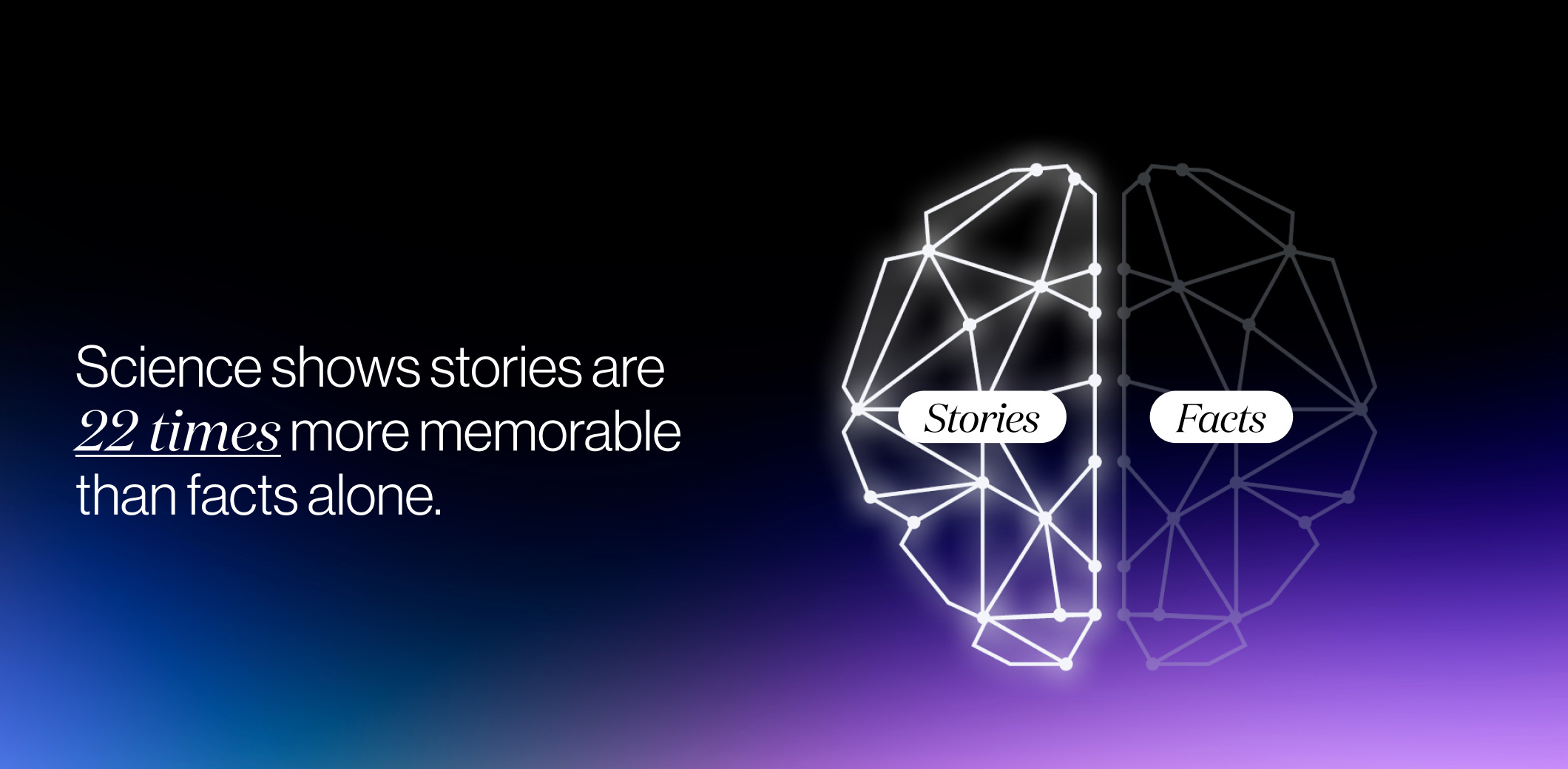
When we hear a fact, our brain activates Broca’s and Wernicke’s areas - the language centres. When we hear a story, our brain does something else entirely.

If a story includes smell, the olfactory cortex lights up.
If it includes movement, the motor cortex engages.
If it involves emotional tension or fear, the limbic system is activated.
If it evokes taste, the gustatory cortex responds.
If it includes sound, like a voice cracking or a siren in the distance, the auditory cortex engages.

This is how the brain experiences stories: not as information, but as simulation.
We live the story in our minds. We feel it. And that’s what makes it stick. This isn’t metaphorical resonance - it’s biological alignment.

Storytelling builds trust, empathy, and belief at the deepest level.
Not because we want it to. But because we are wired for it.


For Founders: A Better Way to Lead Through Story

If you want people to care about your mission, product, or vision, you need more than a message. You need a moment. A reason to believe.

Too many founders describe what they do.
The great ones reveal why it matters.

Here are three essential stories you can develop to help you build emotional connections with your audience.


1. Your Origin
This is not your timeline. It is your turning point. The moment something changed.

Ask yourself:

Abbreviated Example:

“In 2017, while travelling through South America, I saw wild ecosystems thriving next to degraded land. I couldn’t unsee it. That moment planted a seed that became our mission.”


2. Your Purpose
This is your emotional and moral why. It is not about your company.
It is about what your company stands for.

Ask yourself:

Abbreviated Example:

“Our purpose is simple, to restore balance. We believe regeneration must serve nature and the people who protect it. That belief drives everything we do.”


3. Your Vision
This is what you see on the horizon. It should feel real, ambitious, and human.

Ask yourself:

Abbreviated Example:

“We imagine a wilder Earth where people and nature thrive together. A world where stewardship is rewarded, and stories of recovery replace stories of collapse.”

These stories are not just for your pitch deck. They are tools of alignment.
They build belief inside your team, confidence in your investors, and clarity in your brand.

Your job is not to communicate. Your job is to connect.
Story is how you do it. But this is just one side of the coin. These stories are about building emotion, where-as when it comes to marketing, it’s about driving action.

Every time you are working on communications, whether it's a pitch, a landing page, or a policy announcement, come back to this:

Am I offering facts, or am I creating meaning?

Am I informing, or am I connecting?

Does this message explain something, or does it make someone feel something they will not forget?

That is the power of story. And it is where real change begins.

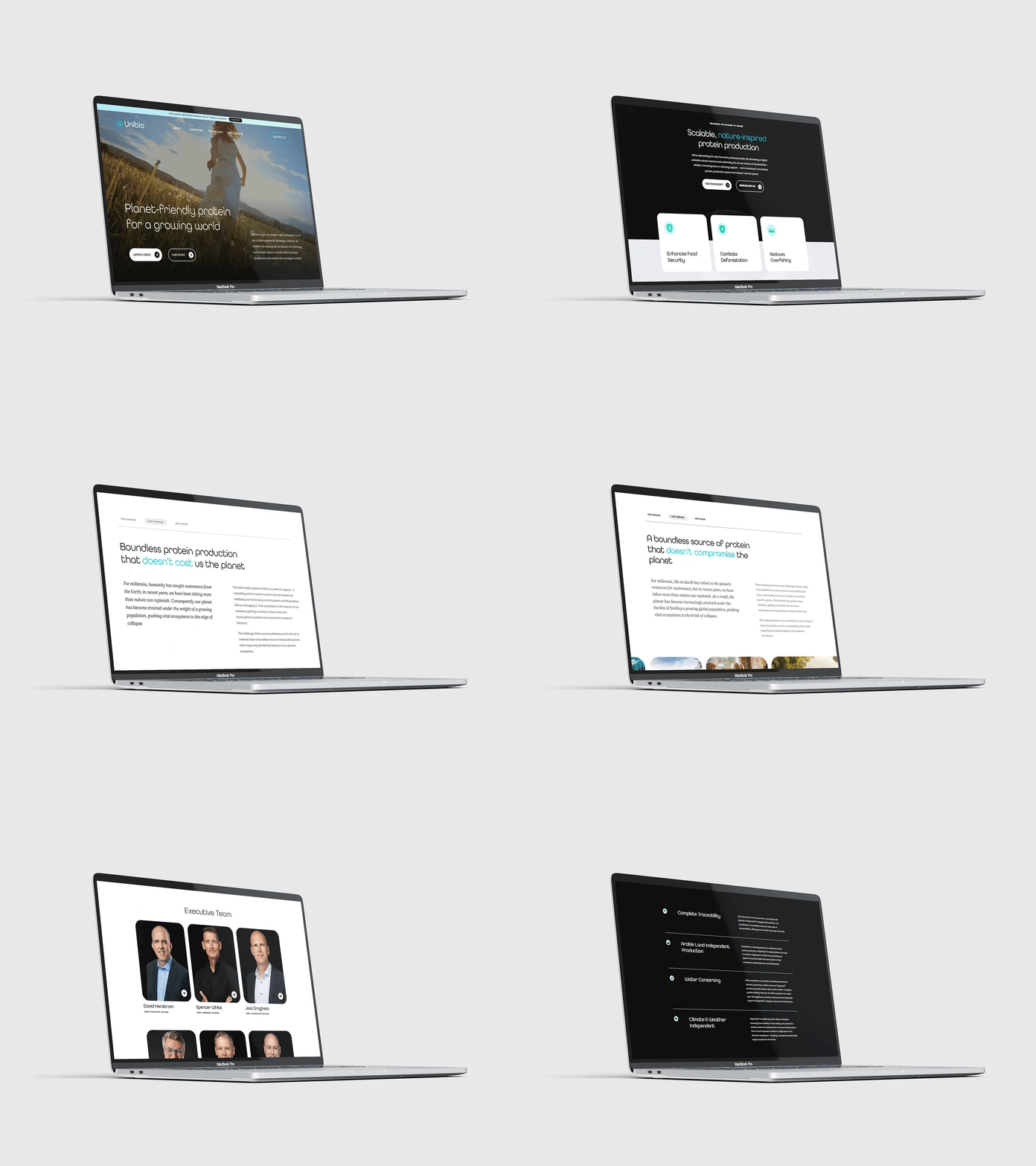
A First Look: Our New Website

We’ve just launched our new website. For us, this isn’t just about a new design. It’s about showing the standard we hold ourselves to, and the reason founders and leaders choose Brighter Future when the stakes are high.

Not every studio is built for this moment. If you’re launching something first-of-a-kind, entering a high-stakes room, or trying to make a complex idea land, you need more than good design. You need:

This is what makes us different. We don’t just polish. We solve the business-critical problem of belief.


Explore Our Services
Whether you’re just starting or striving for new heights, these services are built to deliver results.


Know Someone Who Needs Support?

Refer a founder to Brighter Future Studio and earn a 10% commission on their first project. Let’s help more purpose-led teams win with brand and story. If this story resonated, or if you’re preparing for a high-stakes moment of your own; we’d love to help.

Thanks for reading.

If you’ve made it this far, feel free to share this with a founder, partner, or investor navigating these challenges. Or reach out directly to talk.

Best,

Aaron C. Leaman
LinkedIn | Capabilities Deck

Founder, Brighter Future

Personal: www.aaroncleaman.com
Company: www.BrighterFuture.Studio

← Back to Thinking
Aaron LeamanComplex communications
Essay · The belief gap

Evidence is not belief.

Why the world's most evidenced causes keep stalling, and where belief actually breaks.

You have sat in this meeting. The deck was strong. The data held. Everyone around the table agreed, and some of them even meant it. Then the meeting ended the way the last one did: warm words, no commitment, and a follow-up that will feel exactly like this one. Nobody was wrong. Nothing moved.

I have spent years inside that meeting, in climate, frontier tech and mission-led organisations, and I have stopped accepting the standard explanation for it. The standard explanation is that the room has not yet seen enough: not enough proof, not enough polish, not enough pages. So the team goes away and produces more of all three, and the next meeting ends the same way.

The problem is almost never the evidence. My work is finding the first point where belief breaks, and the decision sitting underneath that point that nobody has made yet. This essay is about that break, because the same one is failing at every scale that matters, up to and including the planet.

The pattern nobody names

Here is the pattern, stated plainly.

Climate science is arguably the largest evidence base ever assembled behind a single conclusion. The IPCC's most recent assessment of the physical science alone drew on more than 14,000 studies. A 2021 review of 88,125 climate papers found that the consensus among publishing scientists now exceeds 99 per cent. If evidence moved the world, this would be the most-moved-on subject in history.

It is not. And the distance is measurable: surveys by Yale's climate communication programme find that only around one in five Americans know the scientific consensus is even above 90 per cent. The evidence is settled. The belief never arrived. The world runs on belief, not just ideas, and belief is the one thing all that evidence has failed to produce at scale.

I started calling this the belief gap in my newsletter years ago. Communication scholars use the same term, and their core finding is blunt: on contested issues, ideology predicts what people believe better than education or information does. The same pattern runs through every room I work in. A founder with peer-reviewed results and a stalled raise. A first-of-a-kind facility that every expert agrees should exist and no one will finance first. A coalition where funders, leadership and partners all nod at the same deck and nothing signs. A ministry with the data, the mandate and a campaign that informs everyone and moves no one.

In each case, the people involved respond the same way. They assume the problem is that others have not yet seen enough. So they produce more: another report, another model, another appendix, another campaign.

And in each case the same uncomfortable truth applies.

Evidence is not belief. Closing that distance is the work.

Why more evidence rarely closes the gap

The instinct to add evidence is natural. Past a point, it is also remarkably ineffective, for two reasons.

The first is order. In most of the material I read, the number arrives before the case. The reader meets the figure that disqualifies you, the capex, the timeline, the ask, before they meet anything that would change their mind. The answer is usually in the material. It is in the wrong place.

The second is deeper. A list of facts engages the brain's language regions and largely stops there. A story recruits more of the machine: read the word cinnamon and the regions that process smell respond; read kick and the areas that move your leg fire. To the brain, a story is closer to an experience than to information about one. And there is a scaling problem underneath. As the numbers grow, the feeling shrinks: the psychologist Paul Slovic calls it psychic numbing, the reason one person in trouble moves us and a million becomes a statistic.

People cannot believe what they cannot first recognise as theirs. Recognition comes before persuasion, always. A wall of evidence built for a general audience recognises no one in particular, and so persuades no one in particular. This is why the most evidenced causes often have the most alienating communications: everything is proven and nothing is felt. And felt is what gets funded. That is not a slogan. A study of early-stage investors found that their gut read on the founder predicted returns better than their formal analysis did.

Governments run into this constantly. Public communication is usually built around one question: what should people know? It asks people to care before it gives them a reason. Communication research has a name for that assumption, the information deficit model, and it has been failing on the record since the early 1990s. The operative question in any room that decides anything is different: what would this specific room need to believe in order to move first? Those are not the same discipline. One informs. The other closes a gap.

Evidence is not belief. Closing that distance is the work.

The oldest version of this story

In 1847, Ignaz Semmelweis showed that when doctors washed their hands in chlorinated lime, deaths of new mothers in his Vienna clinic collapsed, from roughly one in five towards one in fifty. The evidence was about as clean as medicine ever gets. It was rejected for decades.

Not because the data was weak. Because of what believing it required: doctors accepting that they themselves had been carrying the infection. The evidence asked its audience to make a decision they could not face, so the audience declined the evidence. Medicine still calls the pattern the Semmelweis reflex.

I meet its smaller cousins every week. Which brings us to what is actually underneath.

What is actually underneath

In nearly every engagement, when I trace a communications problem back far enough, I find the same thing: a decision nobody has made yet.

It shows up as fragmentation. Three true descriptions of the same organisation, none of them the one, each held by a different person. Every deck, speech and page becomes a negotiation between versions. From the outside it reads as incoherence. From the inside it feels like a delivery problem, something a better writer or a better deck could fix. It is not. It is a depth problem: an unmade decision leaking out as messaging.

Organisations in this state have usually built the shallow version of their story six times instead of the deep version once. The shallow version is assembled outside-in, for each audience, under each deadline. It works until someone asks a real question. The deep version is built inside-out, from what is actually true and actually decided, and because of that it survives pressure. It is the same house with different doors, not a different house for every room.

The work, then, is rarely to write something new. It is to find the first point where what you know to be true stops being believed by the person who has to act on it, name the decision sitting underneath that point, and make it. Most of what is needed already exists. It is in the documents, in the wrong order, or in someone's own words and never written down.

The deadlock at full scale

The hardest version of the belief gap is not one sceptical reader. It is a deadlock: several parties want the outcome, each needs another to commit first, nobody is wrong, and nothing happens.

Capital waits for proof. Buyers wait for a reference. Partners wait for a commitment. Funders wait for alignment. No precedent means nobody wants to be the precedent. Meanwhile the clock runs anyway: budgets cycle, windows close, and the people who believed first begin to hedge. The money shows the same gap the surveys do: the world now deploys roughly 1.5 trillion dollars a year of climate finance against an annual need estimated at nearly six trillion.

This is the structure of the climate transition itself. I wrote last year that innovation is no longer the constraint; coordination is. The technology exists. The capital exists. The demand is emerging. What is missing, room after room, is the case that lets one specific party move first without feeling alone, because it was built around what they, specifically, need to believe.

We talk about collective action problems as if they were economics. Mostly they are narrative problems wearing an economics costume. A Nobel prize has already been won for a version of this argument: Robert Shiller's narrative economics holds that contagious stories, not fundamentals alone, drive booms, crashes and the decisions in between. And on the one occasion a global environmental deadlock genuinely broke, the ozone layer, it broke narrow: a vivid frame, a named set of gases, a specific industry, and first movers whose case for moving was concrete. Game theory says everyone waits. A story, held clearly enough, is how someone stops waiting. Every first mover in history moved on belief before the spreadsheet fully agreed, because a case existed that made moving first survivable.

What closing the gap looks like

I will give you the small, documented version, because small and documented beats grand and vague.

eeden is a German company building chemical recycling for textiles. Real science, real team, and the classic first-mover problem: fashion brands wanted the outcome and nobody wanted to be the precedent. We rebuilt the case around the believer rather than the evidence: what a brand partner would need to see first, in what order, to make moving first defensible inside their own building. Belief is built incrementally, not theatrically. eeden signed a letter of intent with one of the world's leading fashion brands. The work directly contributed to that outcome; the claim is exactly that, and no more.

The pattern transfers to any scale you care to name. Find where belief breaks. Name the decision underneath. Build the one story that survives every room it enters. Then put it in the room and watch what changes.

And what changes is observable. The meeting gets shorter, not longer. The questions move from scepticism to logistics. And the sentence you have been hearing for a year, who else is in, quietly becomes a different one: how do we move.

The work

If you hold evidence that is not being believed, the temptation will always be to add. More proof, more pages, more polish. Resist it long enough to ask the harder question first: where, exactly, does belief break, and what decision is sitting under that point, unmade? You can never ask a room to believe something you have not yet given it the reason to believe.

That question scales. It is the same question for a seed round and a sovereign transition plan. The most important communications work of the next decade, corporate, institutional and governmental, is not information. It is closing the distance between what we can prove and what rooms full of capable people actually believe, one findable break at a time.

Evidence is not belief. Closing that distance is the work. And it is work: findable, nameable, buildable.

The next version of that meeting can end differently.

Aaron C. Leaman works on complex communications problems in climate, frontier tech and mission-led organisations. The Belief Gap Diagnostic is where that work begins.

Sources

The IPCC Sixth Assessment Report, Working Group I (2021), referencing over 14,000 studies. Lynas, Houlton and Perry, Environmental Research Letters (2021), on consensus exceeding 99 per cent across 88,125 papers. Yale Program on Climate Change Communication, on public underestimation of the consensus. Hindman, Journalism and Mass Communication Quarterly (2009), the belief gap hypothesis. González et al., NeuroImage (2006), odour words and olfactory cortex. Hauk, Johnsrude and Pulvermüller, Neuron (2004), action words and motor cortex. Stephens, Silbert and Hasson, PNAS (2010), speaker and listener neural coupling. Slovic, Judgment and Decision Making (2007), psychic numbing. Huang and Pearce, Administrative Science Quarterly (2015), investor gut feel. Wynne, Public Understanding of Science (1992), and Simis et al., Public Understanding of Science (2016), on the information deficit model. Shiller, Narrative Economics, Princeton University Press (2019). Climate Policy Initiative, Global Landscape of Climate Finance (2024). Peer-reviewed histories of Semmelweis and the rejection of hand hygiene.

If this is where you are

The Belief Gap Diagnostic finds the first point where belief breaks in your own material. £4,500, fixed, credited in full against any engagement that follows.

Start a diagnostic

More from Aaron

All insights on the main page