On the 8th of May 2026, a closed-door conversation in Zürich gathered investors, founders, and operators from across the circular materials and biotech space to work through a question that most of the sector’s pitch decks and policy papers quietly avoid: if the technology is ready, and the regulatory pressure is real, why is European circular materials not scaling faster?
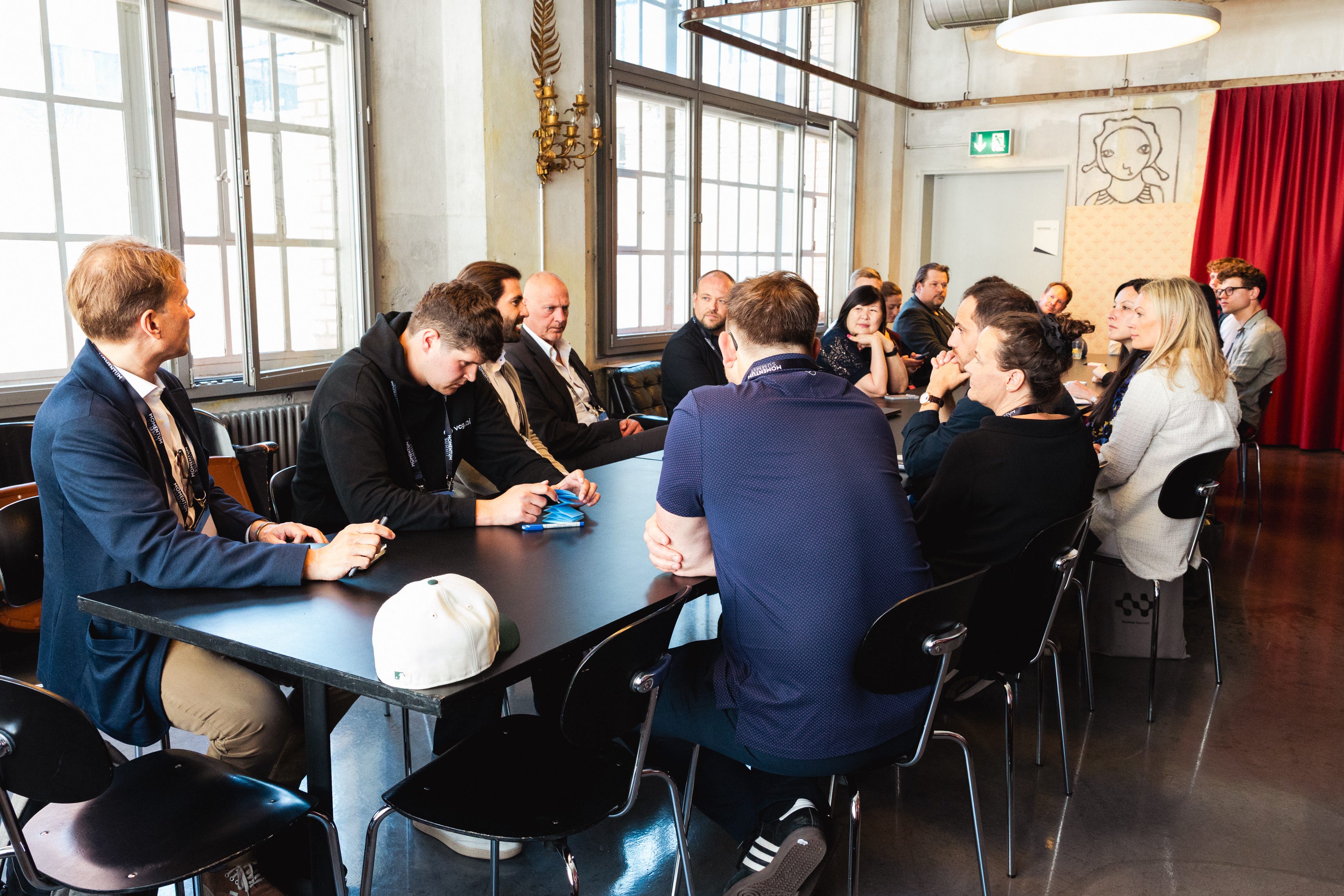
The conversation was hosted by Gemma Corrigan, Senior Advisor to Parley Future Materials, and it did not produce an optimism report. It produced a structural diagnosis. And it produced a counter-thesis to the way most European circular materials companies, and the policymakers supporting them, are framing the scaling problem.
The sector is treating a capital infrastructure problem as if it were a venture problem. It is not. The distinction matters because the solution to a venture problem is more risk-tolerant early-stage capital. The solution to an infrastructure problem is aggregate demand commitments, corporate equity positions, and instruments that do not yet exist in the European toolkit at the required scale.
This essay starts from that conversation, then builds outward. The diagnosis and the core argument are what the room produced. The supporting detail, the named companies, the figures, the policy context, comes from research conducted afterward to test and extend what was said. Where a claim is attributed to “a participant” or “the room,” it reflects something said in the conversation. Everything else is verified independently.
It argues four things.
1). The time for pure sustainability business cases is over. The companies that will scale are those for whom the sustainability proposition and the economic proposition are the same thing.
2). The offtake agreement unlocks everything, but the sequence required to obtain one is structurally impossible for most companies without an instrument that does not currently exist.
3). Feedstock cost is not fixed. It is dynamic, and the moment your competitive advantage becomes visible, it starts to erode.
4). Europe is producing the technology and, in some cases, exporting the scaling opportunity.

The wrong unit of analysis
The conventional framing of the circular materials scaling problem is a venture capital framing. There are excellent companies at the pilot stage. They need growth capital to move from pilot to industrial production. The market is large. The regulatory tailwinds are strong. The investors who move early will capture disproportionate returns.
This framing produces a particular kind of investor activity. It produces seed rounds and Series A rounds and a growing number of European circular materia
ls companies with proven technology at small scale. What it does not produce is the upstream infrastructure that industrial customers need to commit to buying at volume.
The conversation in May named the problem plainly. The circular transition at scale is not a technology problem and it is not primarily a venture capital problem. It is an infrastructure problem. The factories, the processing facilities, the feedstock collection and sorting networks, the logistics chains: all of the physical infrastructure required to deliver recycled or bio-based materials at the volumes that large industrial buyers need does not yet exist. And the instruments required to fund that infrastructure are either absent or inadequately capitalised in the European context.
Treating it as a venture problem produces a consistent failure mode. Companies raise enough capital to prove the technology at pilot scale. They approach large industrial customers. The customer is interested. The customer wants volumes that require a production facility ten to one hundred times larger than the current operation. The customer will not commit to a purchase contract without seeing the facility. The venture investor will not fund the facility without seeing the purchase contract. The company is stuck. The technology works. The loop is broken somewhere else.
What it takes to make one tyre
To understand the scale of the upstream infrastructure problem, it helps to trace one product.
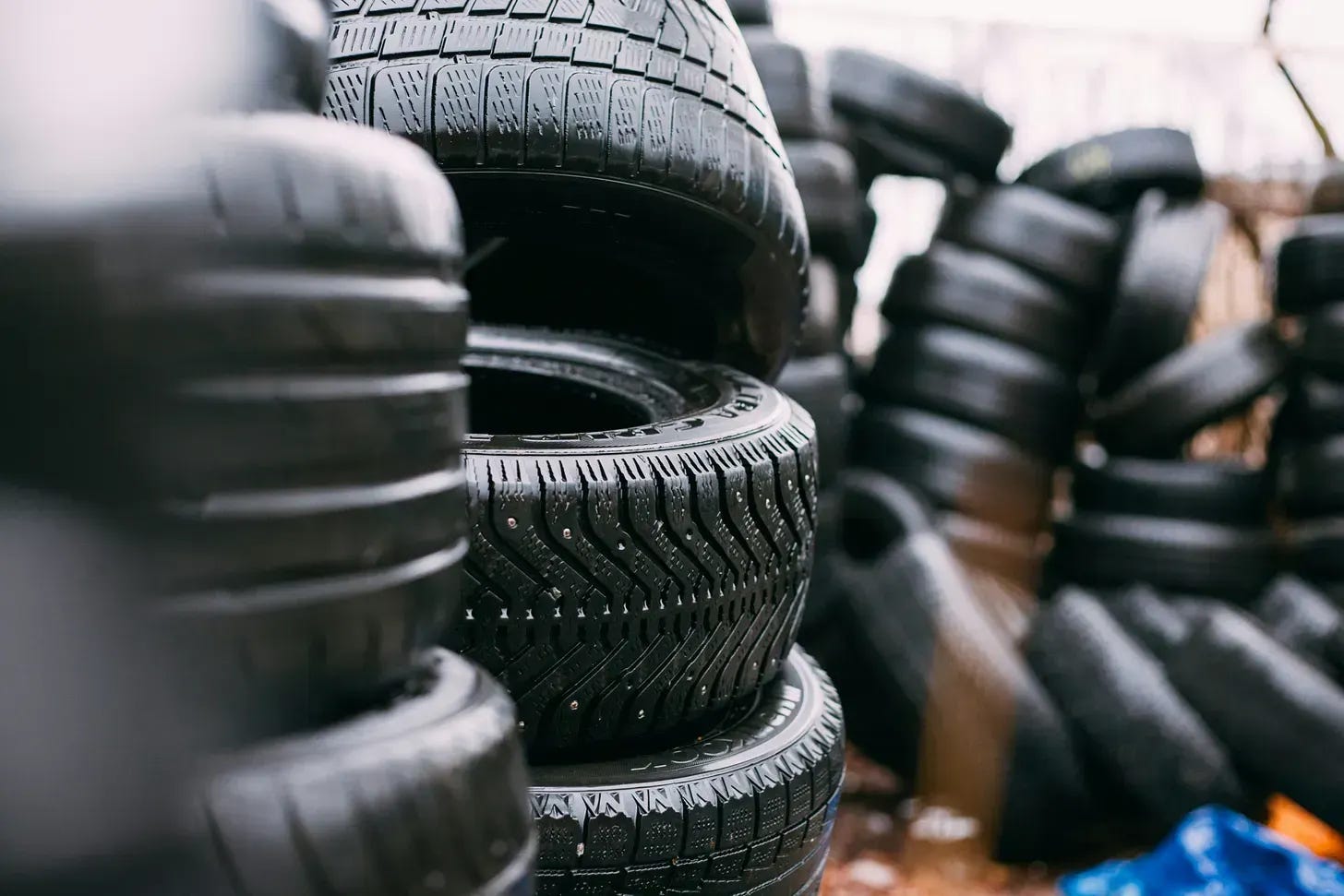
A modern tyre is not just a lump of rubber. It is an engineered composite of around two hundred materials: natural rubber tapped from trees in South East Asia, synthetic rubber derived from petroleum, carbon black produced by burning heavy oil fractions, steel wire, textile cord, silica, sulphur, and a long list of chemical accelerators and stabilisers. Almost every one of those inputs is today either fossil-derived or virgin-mined. To make a tyre circular, each of those streams has to be replaced with a recycled or renewable equivalent that performs identically, at a price the market will bear, at the volume of the hundreds of millions of tyres produced every year. That is not one substitution. It is two hundred substitutions, each with its own supply chain that largely does not yet exist.
Now follow one tyre off one car. Europe generates around 3.5 million tonnes of end-of-life tyres a year, and on paper the story is a triumph: roughly 95% are collected and treated, one of the highest recovery rates of any product in the economy. But watch where the tyre actually goes. Around 40% of that mass is burned, most of it as fuel in cement kilns, more than a million tonnes incinerated every year. Another 55% or so goes to material recovery, and roughly three-quarters of that is ground into granulate and scattered into artificial football pitches, playground surfaces, and road fill. Only a fraction of one percent passes through pyrolysis on a path that could ever return it to a tyre. The circle does not close. A tyre becomes heat, or it becomes a football pitch. It almost never becomes a tyre again. The recovery infrastructure Europe spent decades building was built to get rid of tyres, not to remake them, and that is the difference between a recycling rate and a circular economy.
Michelin, the world’s second-largest tyre manufacturer, has committed publicly to 40% renewable or recycled materials across all tyre production by 2030, and 100% by 2050. In 2024 it was at approximately 31%, up from 28% in 2021. At the current rate of roughly one percentage point per year, Michelin reaches the mid-thirties by 2030, well short of its own target. The gap between trajectory and commitment requires not incremental improvement but structural change in the upstream supply chain.
Each of the inputs that currently comes from fossil or virgin sources needs a substitute. Synthetic rubber, derived from butadiene processed from petroleum. Carbon black, produced by the incomplete combustion of heavy petroleum products. Textile reinforcement, typically virgin polyester or nylon. Each substitution requires a supply chain that does not yet exist at the required scale.
Michelin is not waiting for the market. It has committed more than $20 million jointly to Pyrowave, a Canadian company producing recycled styrene monomer from post-consumer polystyrene via microwave chemical recycling, with the first three-tonne batch shipped to a Michelin plant in France at 99.8% purity. Michelin Ventures holds an equity stake of around 3-4% in Carbios, the French enzymatic recycling company, which can convert post-consumer PET into polyester tyre yarn. Michelin co-founded a joint venture with Scandinavian Enviro Systems and Antin Infrastructure Partners to build what it describes as the world’s first industrial-scale tyre recycling group, targeting approximately 35,000 tonnes of end-of-life tyres per year. It is part of the BlackCycle consortium, thirteen partners working on full tyre-to-tyre recycling.
Fabien Gaboriaud, Michelin’s Senior Vice President for Solutions for Circular Materials, has been direct about what this transition costs: “The cost of fossil materials is much lower than the costs we will have to face to access new renewable and recycled materials. Incorporating these renewable or recycled materials will therefore inevitably lead to a significant increase in initial costs, an economic reality that needs to be taken into account now. Acceptance of these economic impacts by the market will thus be a major challenge.”
That is one tyre manufacturer, building its own supply chain, equity position by equity position, consortium by consortium. The conversation in May put a number on it. One participant estimated that a single large tyre manufacturer, meeting its own renewable-content targets, would need on the order of €10 billion of upstream capex. It is an estimate offered in the room, not an audited figure, and it should be treated as indicative. But the order of magnitude is the point: that is not a sum any startup can supply or any venture fund can finance. What Michelin’s own disclosures confirm is the direction: materially higher input costs, a transition the market will find challenging to accept, and a supply chain that has to be built rather than found.
This is infrastructure finance, not venture.
The offtake-capex lock
The structural problem the room named most clearly was the sequence required to build a circular materials business at industrial scale.
To obtain a purchase contract from a large industrial buyer, you need to demonstrate that you can supply at the volume, specification, and consistency they require. To demonstrate that, you need a production facility at a scale approaching what they need. To build that facility, you need capital. To raise capital at that scale, you need a purchase contract, or at minimum a commercial commitment with enough weight to satisfy a lender’s project finance requirements.
Each step requires the previous one. The sequence is circular. The starting point does not exist.
Carbios is the clearest recent illustration, and it is worth slowing down on, because the company did everything the playbook demands and the playbook still failed it.
By late 2024, the French enzymatic recycling company had spent over a decade proving that its enzymes could break PET plastic back into its original building blocks, ready to be remade as new. It had run a demonstration plant. And it had assembled what may be the strongest offtake consortium in the industry: L’Oréal, L’Occitane, PepsiCo, Nestlé Waters, Suntory, PUMA, Salomon, On. Those are not speculative commitments. They represent real purchasing intent from some of the largest consumer goods companies in the world. The science worked. The customers were signed. Construction of the first industrial plant was under way.
In December 2024, Carbios paused that construction and announced it would cut up to 40% of its workforce. Not because the enzymes had failed. Not because a single customer had walked away. Because the capex financing was not in place. The market had said yes; the capital had said not yet. Construction restarted in 2025, but only after €42.5 million in public funding, including a €30 million grant from ADEME, the French environmental and energy agency, and in May 2025 the first direct sales contracts were signed. Offtake is necessary. It is not sufficient. The instrument that bridges the gap between signed contracts and a funded production facility remains the hardest thing to find.
Infinited Fiber Company in Finland tells a parallel story. Its Kemi flagship factory, designed for 30,000 tonnes of Infinna cotton-like textile per year, has most of its capacity pre-sold through multi-year offtakes with Inditex, PVH, Patagonia, PANGAIA, H&M, and BESTSELLER. It has a feedstock supply agreement with SOEX, one of Europe’s largest textile waste collectors. The factory is the slow part. The €400 million needed to build it has been the binding constraint.
Syre, the Swedish textile-to-textile polyester company launched in 2024 by Vargas Holding and H&M Group, found a different route. H&M signed a $600 million, seven-year offtake before the company had a plant. TPG Rise Climate, the US private equity firm, led a $100 million Series A on the back of that offtake. The sequence was: offtake first, equity second, plant third. Not because the capex-first route is unavailable, but because the offtake de-risks the capex financing enough to attract the capital.
And Renewcell, the Swedish company that pioneered cotton-to-textile recycling with its Circulose product, pre-sold capacity to multiple brands and went bankrupt in 2024 anyway, because pre-sold capacity does not equal a funded plant, and a funded plant does not equal a plant that can produce at the cost required to make the commercial model work.
The lesson the room drew is precise. Offtake is the key that unlocks capital, but capital does not automatically follow the key.
The instrument required to fund production infrastructure at the moment between signed offtake and commissioned plant is the instrument that most consistently does not exist in European circular materials.
There is a darker version of this lock, named after this essay first published by a founder negotiated exactly these kind of deals with industrial buyers before the company was acquired in 2025. Sometimes the pilot is not a step toward a deal. It is a negotiating instrument. A startup develops a credible alternative, the pilot succeeds, an investment is announced, and the incumbent supplier suddenly returns with better pricing. The buyer secures the improved terms, the incumbent keeps the business, and the startup is quietly dropped. The pilot did exactly what it was meant to do, but not for the company that ran it. Seen this way, the question is not why so many pilots fail to become deployments. It is whether some of them were ever meant to.
This sharpens the case for a demand-side coalition rather than weakening it. A buyer pre-committed to purchasing qualifying volume cannot use the pilot as a costless way to squeeze an incumbent, because walking away now carries a price. Organised demand does not just aggregate volume. It takes the pilot off the table as a free option.
When your feedstock stops being free
The third structural finding was operational rather than financial, and it applies as much to companies that have found their feedstock advantage as to those still looking.
Feedstock cost in circular materials is not a fixed assumption. It is a dynamic variable that changes the moment your competitive advantage becomes visible.
The mechanism is documented most clearly in used cooking oil, the most widely traded circular materials feedstock in Europe. A decade ago, used cooking oil was a low-value waste product, sold at $300-500 per tonne for use in soap production and animal feed. The expansion of renewable diesel and sustainable aviation fuel mandates across Europe transformed it into a strategic commodity. By mid-2025, ISCC-certified used cooking oil delivered in Northwest Europe was trading at over €1,100 per tonne. Energy Solutions described the price movement bluntly: “the value uplift is a policy artefact, not a reflection of UCO’s intrinsic energy value.” Neste, one of the largest users, responded by acquiring feedstock suppliers and signing long-term collection partnerships to lock in supply before the price rose further.
The same dynamic appears wherever a waste stream transitions from disposal cost to commercial input. In tyre recycling, Michelin’s move from buyer of recovered carbon black to direct equity investor in Scandinavian Enviro Systems is a vertical-integration response to exactly this risk. In textile recycling, Infinited Fiber secured its SOEX feedstock agreement early, recognising that textile waste would not remain cheap once the industry understood its value.
The implication for founders is that feedstock strategy is not a cost assumption to be set at the point of fundraising. It is an active commercial decision that requires long-term supply agreements, exclusive relationships with feedstock providers, or equity positions in the feedstock supply chain. The advantage is real, but it requires active construction and active defence. Free feedstock is a temporary state. The companies that act on this insight before their competitors recognise the same waste stream are the ones with the durable cost advantage. The ones that treat it as a permanent given are the ones who find, a few years into operation, that their fundamental commercial premise no longer holds.
The equity gap
The fourth structural finding was the one most specific to the European context, and the one that requires the most precise framing.
The conversation observed that the willingness of corporates to take equity positions in upstream circular materials suppliers varies significantly by geography and sector. In critical raw materials, the distinction is clear. The United States has deployed a set of instruments, IRA tax credits, Defense Production Act guarantees, direct equity stakes, and long-term offtake contracts, that together create a market-shaping function for domestic supply chain development. The US Export-Import Bank has $100 billion in critical minerals and supply chain capacity to deploy. The US government took a 15% equity stake in MP Materials, a rare-earth processor, to secure domestic supply. The EU’s Critical Raw Materials Act, adopted in March 2024, sets ambitious 2030 targets of 10% extraction, 40% processing, and 25% recycling of annual EU needs from within the union, with no more than 65% of any strategic raw material from a single third country. The RESourceEU action plan, adopted 3 December 2025, aims to mobilise €3 billion in EU funds within twelve months. Scrap export restrictions on permanent-magnet waste are proposed by Q2 2026. But the Jacques Delors Centre’s assessment is direct: Europe’s instruments “largely repackage existing funds” and have not yet moved to the equity-participation model that would align European industrial capital with the supply chain build-out.
In textiles and bio-based materials, the picture is more mixed. Infinited Fiber’s 2024 funding round brought in TTY Management, the investment vehicle of Tadashi Yanai, founder of Fast Retailing and Uniqlo, as one of its top-three shareholders, alongside Goldwin and Youngone from Korea. Inditex is also a top-three shareholder and has signed an offtake commitment worth more than €100 million. H&M Group holds equity in Worn Again Technologies and co-founded Syre. European fashion brands are not absent from this picture.
The more accurate characterisation is that European industrial corporates outside the fashion sector, particularly in chemicals, automotive, and building materials, have been slower to move from procurement relationships to equity positions in the circular materials companies they intend to source from. Michelin is an exception, and its exceptions are notable precisely because they are exceptions. For most European industrial buyers, the procurement team and the corporate venture or investment arm operate separately. Procurement buys on price and specification today. Investment looks at the supply chain of tomorrow. The company that resolves that tension, so that its procurement function can endorse an equity position in a strategic supplier, is the one that will have the supply chain it needs in 2035.
Winner-take-most
The room’s fifth conclusion was the one that most directly affects the investment timing question.
In conventional materials markets, scale confers advantage but not dominance. Multiple suppliers can compete on price and specification indefinitely. In circular materials, the market structure that is beginning to emerge is different.
The first company to secure a large offtake agreement, build a production facility at the required scale, and demonstrate the economics at industrial volume holds structural advantages that are very difficult for a later entrant to overcome. The advantages are not primarily technological. They are logistical and relational. A company that has built a collection and sorting network for a specific waste stream owns the relationships with the feedstock providers in that geography. Those relationships took years to build and cannot be replicated quickly. A company with a long-term supply agreement with a major brand has a reference customer that de-risks the next commercial conversation. A company that has demonstrated production at scale has the cost curve data that allows it to price competitively while a later entrant is still on the steep part of their learning curve.
In textile-to-fibre, Infinited Fiber and Syre are building the first-mover positions. Renewcell’s 2024 bankruptcy, despite being the category pioneer with pre-sold offtake, shows that first-mover status does not guarantee success if the economics of the plant itself do not work. But Renewcell’s failure also removes a competitor and concentrates demand on the survivors.
In chemical recycling, Carbios in enzymatic PET, and Plastic Energy in pyrolysis with two operating plants in Spain and partnerships with TotalEnergies and ExxonMobil, have accumulated the offtake relationships and the operational track record that new entrants will struggle to replicate without years of commercial development and significant capital.
For investors, the implication is that the period of maximum risk and maximum opportunity coincides. The company currently struggling to close its offtake and fund its production is the company that, if it succeeds, will be structurally difficult to displace. The capital required to bridge that moment is the capital that captures the advantage.
What the room committed to
Three commitments came out of the conversation.
The first was to work toward a first-mover coalition for circular materials, modelled on the aggregate demand commitment structures used in hard-to-abate industrial sectors. A group of industrial buyers committing in advance to purchasing specified volumes of recycled or bio-based materials from qualifying suppliers, at a price that justifies the upstream infrastructure investment. This commitment remains open. The circular materials scaling dynamic is moving faster than the coalition-building.
The second was to examine what it would take for European corporate buyers to take equity positions in circular materials suppliers, and to identify the governance and structural barriers that prevent them from doing so. The fashion sector shows it is possible. The question is what it would take for automotive, packaging, and chemicals companies to reach the same conclusion.
The third was to engage with the developing EU policy framework, including the Critical Raw Materials Act, the RESourceEU action plan, and the Advanced Materials Act expected by Q4 2026, to ensure that the instruments being designed address the specific gap between early-stage innovation funding and production-infrastructure finance.
The Decision Room is convening the cohort that was in the May conversation to begin defining what these three pieces of work look like in practice. The shape will be determined with the room, not handed down to it.
The work is the point. The event is the architecture around it.
If you’d like to stay in the loop with all our upcoming meet ups, including our flagship event in May 2027.
The position
The implication of all this, for any investor, founder, or corporate in the circular materials space, is that the diagnosis of “more venture capital” is wrong. Not unhelpful. Wrong.
The problem is upstream. The infrastructure does not exist. It will not be built by venture capital alone, because venture capital is not structured to fund first-of-a-kind production facilities that require offtake commitments before they can be financed, and offtake commitments before the facility exists to demonstrate the specification.
The companies that will define the circular materials landscape in 2035 are building now. They are building not just the technology but the feedstock relationships, the offtake commitments, and the production infrastructure that no later entrant can easily replicate. The window to establish the dominant position in a given category is shorter than it appears. The regulatory pressure that is making circular materials commercially attractive to industrial buyers is also attracting competition.
The institutions that need to show up, with equity, with demand commitments, with the instruments that bridge the offtake-capex lock, are the industrial buyers who have made the public commitments and are now discovering that the upstream supply chain required to honour them does not yet exist. Michelin has understood this. The question is how many of its peers will reach the same conclusion before the positions are taken.
The room in Zürich was not unanimous on every point. There were sharp disagreements on whether the EU’s regulatory instruments are calibrated to the actual investment timeline, on whether CDMOs are a bridge or a dependency trap, and on whether the winner-take-most dynamic could be interrupted by a well-capitalised late entrant with better technology. There was no disagreement on the diagnosis. This is an infrastructure problem. Until it is treated as one, the technology will continue to work at pilot scale and stall on the way to industrial volume.
Edition II will return to this question with the coalition work tracked and the equity gap mapped. The next gathering is on 11th of May 2027 in Zürich. The work between now and then is not the event. It is the architecture being built around it.
If your work intersects with what the room described, the door is open.
Ways in.
Apply for Edition II. The founding allocation is open now, for those who joined us on the 8th May, at the lowest price The Decision Room will ever be priced. The full event is capped at 400. Each roundtable is capped at 20. → Apply for founding access
Partner the room. Co-host a roundtable. Shape the programming. Sit at every conversation that matters to your thesis. → Read the Partner File → Apply to partner
Read the full record. Before Capital Flows is the published record from all eight closed-door conversations at Edition I. → Before Capital Flows
Reply to this email if any of the work streams above are yours. We will be in touch directly.
Co-founder,
The Decision Room aaron@thedecisionroom.net
The Decision Room is an invite-led climate and frontier-tech capital convening. Once a year. Zürich. This essay is the second in the series, one per closed-door conversation from Edition I. Written by Aaron C. Leaman The full record is Before Capital Flows.